
How to Feel Beautiful During Pregnancy Photos: A Guide
Table of Contents
Why You Might Not Feel Beautiful Right Now
The Best Time for Maternity Photos to Capture Your Glow
Weeks 28 to 34: The Sweet Spot
Maternity Photoshoot Outfit Ideas That Flatter Every Bump
Fabric, Fit, and Color Tips for Bump Photos
Professional Maternity Makeup and Styling for a Radiant Look
Maternity Photography Posing Guide for Specific Insecurities
If You're Self-Conscious About Your Arms
If You're Self-Conscious About Swelling or Your Legs
If You're Self-Conscious About Stretch Marks or Skin Texture
If You're Self-Conscious About Your Face or Double Chin
If You're Self-Conscious About Your Overall Size
Budget-Friendly DIY Pregnancy Photos You Can Take at Home
When to Seek Mental Health Support for Body Image Concerns
The Difference Between Discomfort and Distress
Body Dysmorphia and Pregnancy
Screening and Support Pathways
What to Tell Your Photographer
Conclusion
Frequently Asked Questions
Last Updated: September 14, 2026
Why You Might Not Feel Beautiful Right Now
If you're wondering how to feel beautiful during pregnancy photos, start by accepting that the mirror and your emotions rarely agree at eight months. Your body is changing faster than your self-image can keep up, and that gap is normal. At K-Rae Images, we hear the same worry before almost every maternity session: "Won't the camera just highlight everything I'm insecure about?" It won't.
A maternity photo session is not a body audit. It's visual storytelling about anticipation, softness, and the person your baby already knows. Treat the camera like a witness, not a judge. Confidence shows up on camera, and it is built before the shutter ever clicks.
Key Takeaway You do not need to feel beautiful before your session. You need a plan, a supportive team, and about ninety minutes. The feeling follows the photographs, not the other way around.
The Best Time for Maternity Photos to Capture Your Glow
The best time for maternity photos is generally between 28 and 34 weeks, when your bump is clearly defined but your energy still holds up for a full session. Schedule too early and the bump reads small; schedule too late and comfort becomes the limiting factor.
Weeks 28 to 34: The Sweet Spot
This window works for most pregnancies because your belly has rounded out, your skin often carries that pregnancy glow, and you can still stand, sit, and shift positions without exhaustion. Mothers carrying twins or managing specific health conditions often photograph earlier, so treat this as a guideline, not a rule. If you're planning multiple looks, book while you still feel steady on your feet.
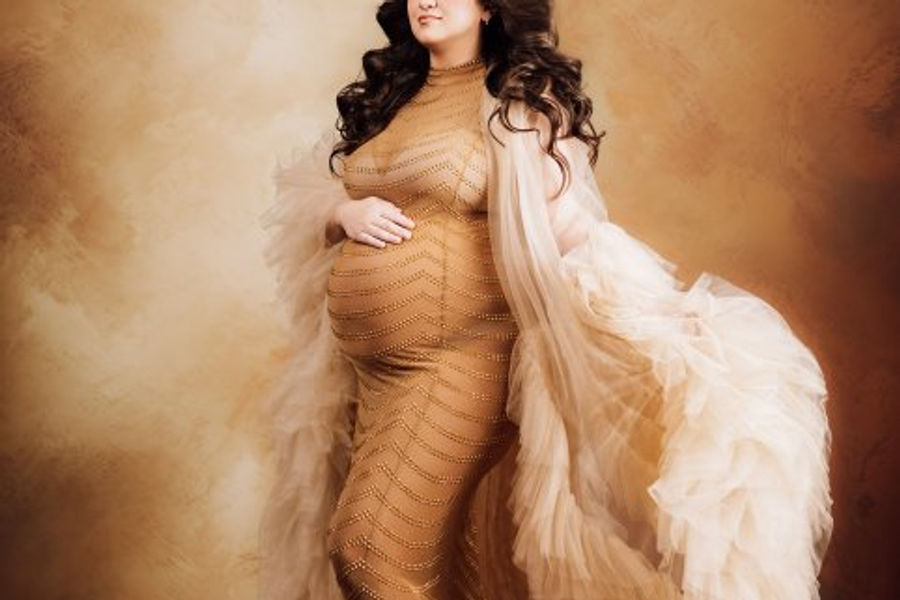
Golden Maternity In Studio shoot at K-Rae Images Professional Photo Studio
Maternity Photoshoot Outfit Ideas That Flatter Every Bump
The most flattering maternity photoshoot outfit ideas:
Fabric, Fit, and Color Tips for Bump Photos
Fabric: Chiffon, jersey, and stretch lace flow with movement and hide the lines of undergarments. Do I still like tight fitting clothes, and see through looks - you bet!
Fit: Empire waists sit above the bump; wrap styles let you adjust as the session goes on.
Color: Soft neutrals, dusty rose, sage, and cream photograph warmly against most skin tones. Save bold prints for one accent piece.
Layers: A sheer robe or knit cardigan adds texture and gives you something to do with your hands.
This is where a client closet changes the experience. Instead of ordering five gowns online and returning four, you try them on in person with someone who knows what photographs well. I also use silks like in the below image for a more fine art look.

Pro Tip Bring your own well-fitting nude and black undergarments. Gowns photograph beautifully, but the wrong bra strap or seam will show through sheer fabric under studio lighting.
Professional Maternity Makeup and Styling for a Radiant Look
Professional maternity makeup and styling exists to make you look like yourself on your best day, not like someone else. Camera lighting flattens features, so photography makeup is built slightly stronger than everyday wear: defined brows, soft lashes, a touch of lip color. This polished aesthetic serves as the perfect foundation for maternity formal wear, ensuring your ensemble remains as cohesive and intentional as your portrait session.
Two practical notes matter more than any product. First, skin prep: hydrated skin reflects light evenly, so gentle exfoliation and moisturizing in the days before your session does more than any highlighter. Second, comfort: tell your stylist about sensitivity to scents, adhesives, or anything touching your skin. If you're managing acne, melasma, or stretch marks, say so up front. A good stylist treats that as information, not a problem.
Maternity Photography Posing Guide for Specific Insecurities
A maternity photography posing guide is only useful if it addresses what you're actually worried about. Generic "stand here and smile" direction ignores the real question: how do I look at ease in a body I'm still getting used to? The answer is not one universal pose, it's a short list of adjustments matched to the area you're self-conscious about. Below are the concerns maternity photographers hear most often, and the posing mechanics that address each one.
If You're Self-Conscious About Your Arms
The instinct is to press your arms flat against your sides, which makes them read wider. Instead:
Rest one hand on your bump and let the other arm bend softly at the elbow, creating a triangle of negative space between arm and waist.
Turn your body about 45 degrees from the camera and let the far arm fall behind you. The near arm stays forward and slightly bent.
Hold a prop, a swaddle, a small bouquet, a letterboard, to give your hands a purpose and keep arms away from the body.
Ask your photographer to shoot from slightly above eye level for standing portraits; this angle naturally slims the upper arms.
If You're Self-Conscious About Swelling or Your Legs
Swelling in the feet, ankles, and calves is common in the third trimester and shows up in full-length frames (mayoclinic.org). Practical fixes:
Wear a floor-length gown. Chiffon and jersey drape over the legs and eliminate the problem entirely.
If you want a seated pose, cross at the ankles rather than the knees and angle both legs to one side. This lengthens the line from hip to toe.
Shift your weight to the back leg and point the front toe slightly. The front leg reads longer and the back leg reads narrower.
Schedule your session earlier in the day if swelling worsens by afternoon. Most expectant mothers find their ankles are smallest in the morning.
If You're Self-Conscious About Stretch Marks or Skin Texture
Stretch marks are one of the most common concerns photographers hear, and lighting solves most of it:
I will do a lot of side lighting rather than flat frontal light. Side light rakes across the skin and softens texture instead of highlighting it.
Draped fabric, a sheer robe, a knit wrap, a gown pulled up over the bump, covers the areas you want covered while still showing the shape of the pregnancy.
A seated pose with a gown pooled around you hides the hips and thighs while keeping the bump as the focal point.
If You're Self-Conscious About Your Face or Double Chin
Camera angle matters more than any makeup trick here:
Rest your chin on your hand or on your partner's shoulder for a few frames. It changes the angle of the neck and softens the jawline.
Laugh on purpose. A genuine laugh photographs better than a held smile and naturally elongates the neck.
If You're Self-Conscious About Your Overall Size
The single most flattering adjustment for any body type is the profile turn. Stand at a 45-degree angle to the camera, hand on the bump, weight on the back leg. This shows the shape of the pregnancy rather than the width of the body, and it works at any size.
Pro Tip Bring a list of your two or three biggest concerns to your session and hand it to your photographer before you start. A good maternity photographer builds the posing plan around that list, not around a preset shot list.
Watch Out Holding a stiff pose for too long is the fastest way to look tense in every frame. Ask for breaks, and ask to sit between setups. A session that respects your stamina produces better images than one that pushes through discomfort.
Budget-Friendly DIY Pregnancy Photos You Can Take at Home
You can absolutely take meaningful pregnancy photos at home. What matters most is light and timing, not equipment.
Shoot within two hours of sunrise or before sunset near a large window.
Wear one gown you love rather than five outfits you tolerate.
Use a phone tripod and the timer function; take twenty frames to get three keepers.
Include one detail shot: hands on the bump, a onesie laid out, the nursery corner.
Ask your partner to shoot from slightly below eye level to elongate the silhouette.
What home sessions can't replicate is professional lighting, styling, and heirloom printing. Many families do both: casual bump photos at home and one full studio session for the images they'll frame.
When to Seek Mental Health Support for Body Image Concerns
Body image distress during pregnancy deserves the same attention as any other perinatal health concern, and it is the topic most maternity photography guides skip. Feeling uncomfortable in a changing body is common. Feeling consumed by it is different, and support exists.
The Difference Between Discomfort and Distress
Most expectant mothers have moments of not recognizing their reflection, a normal response to rapid physical change. The line to watch for is function:
Are thoughts about your appearance interfering with sleep or appetite?
Are you avoiding social events, medical appointments, or the camera in ways you didn't before?
Are you weighing yourself compulsively, restricting food, or over-exercising to manage the changes?
Do you feel detached from your body, as though it belongs to someone else?
If you answered yes to any of these, that is a signal to talk to your OB provider or a perinatal mental health specialist, not something to push through until the baby arrives.
Body Dysmorphia and Pregnancy
Body dysmorphic disorder (BDD) is a recognized mental health condition in which a person becomes preoccupied with a perceived flaw in their appearance that others may not see (Obsessive-Compulsive Disorder (OCD)). Pregnancy can intensify BDD symptoms because the body is changing in ways the person cannot control. If you have a history of BDD, an eating disorder, or past trauma related to your body, tell your OB provider early in the pregnancy and your photographer before the session. A maternity session can be adapted, shortened, or rescheduled, and no image is worth your emotional well-being.
Screening and Support Pathways
Several well-established resources exist for perinatal mental health support:
Your OB or midwife can screen for perinatal mood and anxiety disorders using standard tools and refer you to a specialist.
Postpartum Support International operates a helpline and maintains a directory of perinatal mental health providers across the country.
The National Alliance on Mental Illness (NAMI) offers information and local support groups.
The 988 Suicide and Crisis Lifeline is available by call or text if you are in crisis.
Asking for help is not a sign that you are ungrateful for the pregnancy. It is a sign that you are paying attention to your whole health, exactly what your baby needs from you.
What to Tell Your Photographer
You do not owe anyone an explanation, but a short heads-up helps your session go better:
"I'm feeling anxious about being photographed. Can we start with a few easy poses?"
"I have a history of an eating disorder. Please avoid comments about my body or weight."
"I may need to stop and sit down partway through. Is that okay?"
A professional maternity photographer will treat all of this as information, not a problem. If a photographer dismisses your concerns or pushes you past your comfort level, find someone else.
Key Takeaway Feeling beautiful during pregnancy photos is not a requirement for taking them. Feeling safe and supported during the session is. If mental health support is part of what gets you there, that is a strength, not a weakness.
Conclusion
The hardest part of a maternity session isn't the posing or the outfit. It's walking in believing you belong in front of the camera. K-Rae Images was built for exactly that moment, with professional hair and makeup, a client closet of couture maternity gowns, a fully stocked studio, and a team that handles every detail from refreshments to heirloom artwork installation. Reach out today and let us show you how beautiful this chapter already is.
Frequently Asked Questions
How can I feel more confident during my maternity photoshoot?
Focus on what your body is doing rather than how it looks. Wear clothes that feel comfortable and flattering, and trust your photographer to guide you. A professional maternity session often includes hair and makeup, which can boost confidence. Remember that pregnancy photos are about capturing a fleeting, powerful chapter. Many mothers find that once they see the first few images, they feel more beautiful than expected.
What month of pregnancy is best for maternity photos?
Most photographers recommend scheduling your maternity session between 28 and 32 weeks. At this stage, your bump is clearly visible, but you likely still have enough energy and comfort to move through poses. If you are carrying twins or have a high-risk pregnancy, your provider may suggest an earlier timeframe. The best time for maternity photos depends on your unique pregnancy, so discuss timing with your photographer early.
How do I choose the right outfit to feel beautiful during pregnancy photos?
Start with fabrics that stretch and drape, like jersey or chiffon, in colors that complement your skin tone. Avoid busy prints that distract from your face and bump. A well-fitted maxi dress or a flowing gown with an empire waist works well for many body types. If you are unsure, ask your photographer for maternity photoshoot outfit ideas. Many studios offer a client closet with gowns designed specifically for pregnancy photos.
What are some flattering poses for a maternity photo session?
Poses that create angles and curves tend to be most flattering. Try standing with one hand under your bump and the other resting on your hip, or turn slightly sideways to emphasize your profile. Sitting poses with legs extended can elongate your body. Your photographer may also use soft lighting and flowing fabrics to highlight your pregnancy glow. A maternity photography posing guide can help you practice at home, but professional direction during the session makes a big difference.
Reach out Today


Comments